New publication
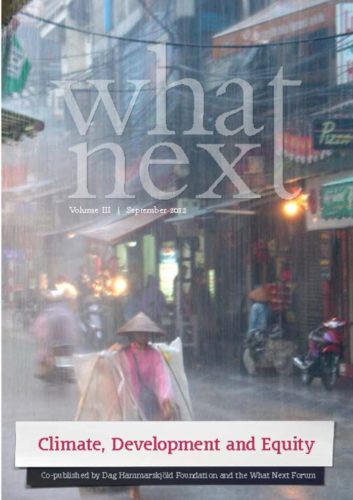
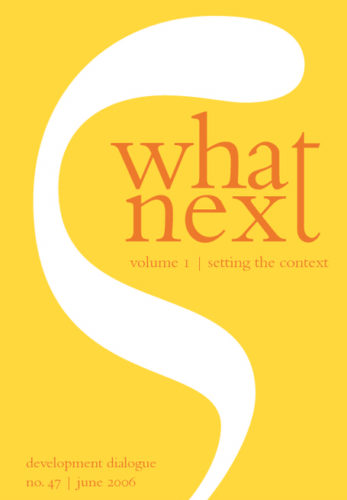
What Next Volume III: Climate, Development and Equity
An all new What Next publication!
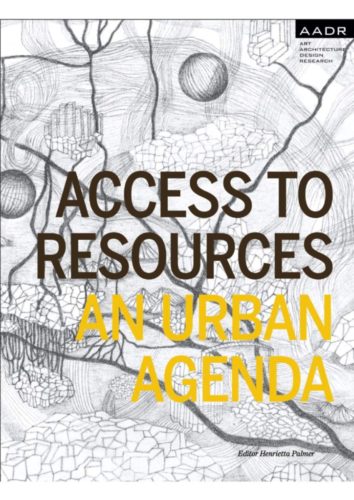
Check out this thought-provoking, challenging What Next Volume – now available electronically, as well as in hard copy.
This What Next Volume presents voices from across the North and South, addressing the combined challenges of climate, development and equity. It highlights the urgency of taking action, but also shows why any attempt to tackle climate change must be grounded in equity. How will humanity fairly divide the rapidly diminishing global carbon budget, while allowing billions of people in the global South (and North) the means for economic, social and environmental well-being? How can United Nations negotiations move forward, and what are the real and false solutions?
This richly illustrated 360-page publication in full color contains 22 articles by the most insightful scholars, activists and scientists from both the South and the North.
Click here for table of contents, download links and more!
Check out this thought-provoking, challenging What Next Volume – now available electronically, as well as in hard copy.
This What Next Volume presents voices from across the North and South, addressing the combined challenges of climate, development and equity. It highlights the urgency of taking action, but also shows why any attempt to tackle climate change must be grounded in equity. How will humanity fairly divide the rapidly diminishing global carbon budget, while allowing billions of people in the global South (and North) the means for economic, social and environmental well-being? How can United Nations negotiations move forward, and what are the real and false solutions?
This richly illustrated 360-page publication in full color contains 22 articles by the most insightful scholars, activists and scientists from both the South and the North.
Click here for table of contents, download links and more!
These contributions from some of the world’s most far-sighted commentators should be required reading for heads of state, policymakers, journalists, activists and the concerned public. Together they make the loudest call for political and individual action and give governments the legitimacy to act.
John Vidal, Environment Editor, The Guardian

New video
Presentation + Q&A/discussion from the seminar 'Behind the Consumption Smokescreen' (1 hours). Kevin's presentation begins at min 16, and largely follows his article in the What Next Volume III book. Download the article in English or Swedish.
Kevin Anderson 'Real clothes for the empereror: Facing the challenges of Climate Change
Presentation + Q&A/discussion from the seminar 'Behind the Consumption Smokescreen' (1 hours). Kevin's presentation begins at min 16, and largely follows his article in the What Next Volume III book. Download the article in English or Swedish.
New publication
Kevin Anderson
Klimatförändringar bortom farlighetens gräns – Brutala siffror och skört hopp
Kevin Anderson

A Swedish translation of Kevin Anderson's great opening article in the book 'What Next Volume III: Climate, Development and Equity'.
Download as pdf for printing or further distribution!
» Single page format
» 2-page spread format
Download as pdf for printing or further distribution!
» Single page format
» 2-page spread format
Recent seminar
What Next Forum, Cogito and WWF
13-17, 8 November 2012, Kulturhuset, Studio 3, Stockholm
Behind the consumption smokescreen – How can Sweden become a true role model in climate action?
What Next Forum, Cogito and WWF
13-17, 8 November 2012, Kulturhuset, Studio 3, Stockholm
This climate justice oriented seminar critically examined Sweden and its action on climate change behind the consumption smokescreen. How much of Sweden's emissions has actually moved to other countries that are now producing the goods we consume? What does it take for Sweden to become a real role model and take on commitments on par with what science requires and in line with its historical responsibility and any notion of 'fairness' and 'equity'?
This seminar, co-organised with Cogito and WWF Sweden, featured two of the authors of the What Next Volume III publication: Kevin Anderson, Tyndall Centre for Climate Change Research and Dale Wen, Third World Network, as well as Glen Peters, Centre for International Climate Research). In the final panel the presenters were joined by a Roger Tiefensee, representing the Swedish government, Helena Leander, the Green Party, and Stefan Henningsson, WWF.
Download a pdf-version of the invitation.
This seminar, co-organised with Cogito and WWF Sweden, featured two of the authors of the What Next Volume III publication: Kevin Anderson, Tyndall Centre for Climate Change Research and Dale Wen, Third World Network, as well as Glen Peters, Centre for International Climate Research). In the final panel the presenters were joined by a Roger Tiefensee, representing the Swedish government, Helena Leander, the Green Party, and Stefan Henningsson, WWF.
Download a pdf-version of the invitation.

Click here for more images from the seminar (including breakfast seminar at the Swedish Parliament organized
Recent book launch
What Next Forum and Dag Hammarskjöld Foundation
17-18, 8 November 2012, Kulturhuset, Studio 3, Stockholm
Development Dialogue no. 61/What Next Volume III: Climate, Development and Equity
What Next Forum and Dag Hammarskjöld Foundation
17-18, 8 November 2012, Kulturhuset, Studio 3, Stockholm
The formal launching of the new What Next Volume III/Development Dialogue no 61 took place at Kulturhuset, Stockholm, immediately following the seminar 'Behind the consumption smokescreen' on 8 November 2012.
Download a pdf-version of the invitation.
Recent seminar
20 September 2012, Stockholm
Rio +20 or Silent Spring-50? What Next after Rio? How can Sweden take international leadership on precaution and technology assessment?
20 September 2012, Stockholm
This seminar with Pat Mooney and Silvia Ribeiro from the ETC Group, highlighted some of the biggest, but yet least discussed issues we are facing in the coming decades: the potential impacts of new, emerging technologies and societies’ ability to deal with these in fair and sustainable manners.
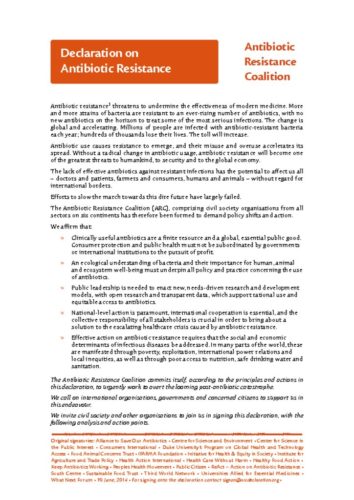
Reflecting on successful work on technology assessment and reaffirmation of the moratorium on ocean fertilization (a geoengineering scheme) in the Rio+20 process, Pat and Silvia opened up for discussion on the way forward, both in terms of the upcoming Convention on Biological Diversity COP in Hyderabad in October 2012, as well as beyond.
Sweden (and Norway) played particularly constructive roles in the area of Technology Assessment at Rio+20, and the seminar both encouraged and demanded that Sweden continue on such a track.
The Swedish Enviornment Ambassdor Annika Markovic participated in the last, policy-oriented part of the seminar.
Reflecting on successful work on technology assessment and reaffirmation of the moratorium on ocean fertilization (a geoengineering scheme) in the Rio+20 process, Pat and Silvia opened up for discussion on the way forward, both in terms of the upcoming Convention on Biological Diversity COP in Hyderabad in October 2012, as well as beyond.
Sweden (and Norway) played particularly constructive roles in the area of Technology Assessment at Rio+20, and the seminar both encouraged and demanded that Sweden continue on such a track.
The Swedish Enviornment Ambassdor Annika Markovic participated in the last, policy-oriented part of the seminar.
For a copy of the original invitation to the seminar – click here!
The seminar was jointly organized by What Next Forum, The Development and Resilience Programme (Swedbio) at Stockholm Resilience Centre, and the Right Livelihood Award Foundation.
New publication
8 April 2012
8 April 2012
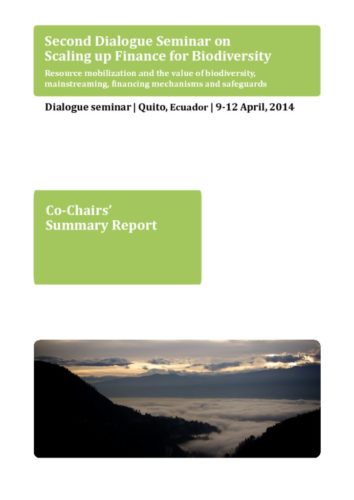
Co-chair's summary from seminar on Scaling up Biodiversity Financing
The Co-chairs' summary from the dialogue seminar "Scaling up Biodiversity Financing" is now ready and available for download and further distribution (now also in Spanish version). The report summarizes the presentations as well as group and plenary discussions.
The aim of the seminar was to provide opportunity for understanding both convergences and divergences on the controversial issues around biodiversity financing, and in particular, the role of "innovative" market mechanisms.
The Co-chair's summary shows a surprising degree of convergence in perspectives on the importance of fiscal reform and public finance mechanisms, and a recognition of the limited scope and risks with an overoptimistic reliance on new "markets". The "Co-chairs' Summary" of the meeting will serve as an "INF" document to the formal CBD negotiations both at the Working Group on the Review of Implementation (WGRI-4) meeting in Montreal in May 2012, and at COP 11 in Hyderabad, October 2012.
Niclas Hällström of What Next Forum collaborated closely with Swedbio throughout the process, including the drafting and finalization of the report.
The aim of the seminar was to provide opportunity for understanding both convergences and divergences on the controversial issues around biodiversity financing, and in particular, the role of "innovative" market mechanisms.
The Co-chair's summary shows a surprising degree of convergence in perspectives on the importance of fiscal reform and public finance mechanisms, and a recognition of the limited scope and risks with an overoptimistic reliance on new "markets". The "Co-chairs' Summary" of the meeting will serve as an "INF" document to the formal CBD negotiations both at the Working Group on the Review of Implementation (WGRI-4) meeting in Montreal in May 2012, and at COP 11 in Hyderabad, October 2012.
Niclas Hällström of What Next Forum collaborated closely with Swedbio throughout the process, including the drafting and finalization of the report.
Recent seminar
6-9 March, 2012, Quito, Ecuador
Scaling up biodiversity finance
6-9 March, 2012, Quito, Ecuador
What Next Forum contributed in a contracted support function to help out with the planning, seminar methodology, programme development, technical assistance (website design and maintenance and documentation), and drafting/editing of the seminar report.


Check out the seminar website with a compilation of 30 powerpoint presentations and lots of reading material. The website has the ambition to function as a growing resource/literature hub for biodiversity financing material.
Click here for photos from the seminar.
Click here for a slideshow from the seminar.
Click here for photos from the seminar.
Click here for a slideshow from the seminar.
Recent seminar
28 Nov - 9 Dec 2011, Duban, South Africa
Globally Funded Feed-in Tariffs at COP17
28 Nov - 9 Dec 2011, Duban, South Africa
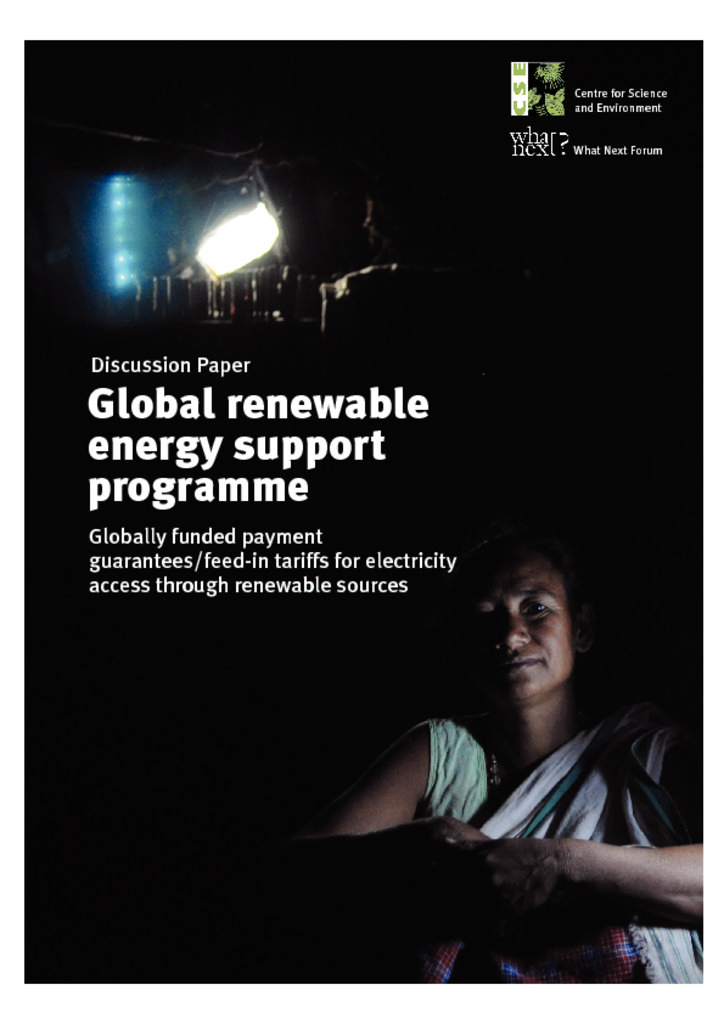
Niclas Hällström participated at the COP17 negotiations in Durban representing both the What Next Forum, as well as working on behalf of the Swedish Society for Nature Conservation (SSNC). One of the main purposes was to highlight and stimulate discussions around the idea of Globally Funded Feed-in Tariffs.
On 4 December, the Swedish Society for Nature Conservation organized, together with the International Network for Sustainable Energy (INFORSE) and Helio International, the side event "Renewable Energy Policies: Climate resilience, Sustainable Development and Poverty Reduction". Niclas Hällström, What Next Forum, presented on behalf of the Swedish Society for Nature Conservation.
Link to side event presentation as pdf to the left.
On 4 December, the Swedish Society for Nature Conservation organized, together with the International Network for Sustainable Energy (INFORSE) and Helio International, the side event "Renewable Energy Policies: Climate resilience, Sustainable Development and Poverty Reduction". Niclas Hällström, What Next Forum, presented on behalf of the Swedish Society for Nature Conservation.
Link to side event presentation as pdf to the left.

Recent event
28 Nov - 9 Dec 2011, Duban, South Africa
Photos and analysis from COP17 inDurban
28 Nov - 9 Dec 2011, Duban, South Africa

Check out lots of photos and slideshows from both the negotiations and the demonstrations at the What Next Forum Photo pages.
New publication
By Vicki Johnson and Niclas Hällström
Rio+20 Challenge paper: Energy resources and services – Achieving universal access to energy and a low carbon, high well-being economy
By Vicki Johnson and Niclas Hällström
This Rio +20 Challenge paper was written jointly by Victoria Johnson, New Economics Foundation and Niclas Hällström, What Next Forum as input to the Rio +20 process. The paper is one in a number of Challenge papers published by the Global Transition 2012 initiative – a joint collaboration between the New Economics Foundation, Stakeholder Forum and New Economics Institute.
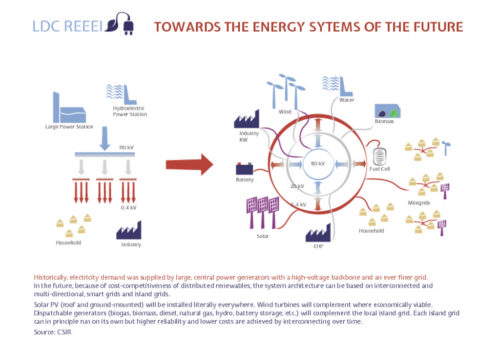
The paper discusses a number of challenges to energy and development, and presents the idea of globally funded feed-in tariffs as a significant part of a solution.
Download the Challenge paper in pdf-format.
Link to overview with all the Challenge papers.
The paper discusses a number of challenges to energy and development, and presents the idea of globally funded feed-in tariffs as a significant part of a solution.
Download the Challenge paper in pdf-format.
Link to overview with all the Challenge papers.
Past roundtable seminar
Pat Mooney
14 Oct 2011, 9.30-12.00, Stallet, Stockholm Resilience Centre, Stockholm
What Next? Geo-engineering, nanotechnology, synthetic biology: The case for international technology assessment at Rio +20
Pat Mooney
14 Oct 2011, 9.30-12.00, Stallet, Stockholm Resilience Centre, Stockholm

This roundtable discussion with Pat Mooney was organized jointly by the What Next Forum and The Resilience and Development Programme (SwedBio) at Stockholm Resilience Centre.
All together 19 persons, with backgrounds in civil society, the Swedish Ministry for Environment, the Swedish EPA, the research community and sustainable development consultancy participated in a rich discussion, initiated and inspired by an overview by Mooney.
The discussions provided a strong case for establishing an international mechanism for technology assessment, something Sweden could take a lead in promoting as an outcome of the Rio +20 summit in June 2012.
Download the Invitation to the seminar as pdf
Download "Why Technology Assessment" (3 pages) as pdf
All together 19 persons, with backgrounds in civil society, the Swedish Ministry for Environment, the Swedish EPA, the research community and sustainable development consultancy participated in a rich discussion, initiated and inspired by an overview by Mooney.
The discussions provided a strong case for establishing an international mechanism for technology assessment, something Sweden could take a lead in promoting as an outcome of the Rio +20 summit in June 2012.
Download the Invitation to the seminar as pdf
Download "Why Technology Assessment" (3 pages) as pdf
Check out ETC Group publications on geopiracy, nanotechnology
and synthetic biology!
Past open lecture
Pat Mooney
12 Oct 2011, 15.00-17.00, Bertil Hammer lecture hall, Blåsenhus, von Kraemers Allé 1, Uppsala
What Next? The World in 2035: Erosion, Technological Transformation and Corporate Concentration - or Alternatives?
Pat Mooney
12 Oct 2011, 15.00-17.00, Bertil Hammer lecture hall, Blåsenhus, von Kraemers Allé 1, Uppsala
The What Next Forum and Centre for Environment and Development Studies (Cemus) jointly organized an open lecture with Pat Mooney, one of the most prophetic analysts of future trends, as well as one of the most effective scholar-activists and shapers of global policy.
In the lecture, Pat shared a 30-year perspective on the future – both worrisome business-as-usual scenarios and more hopeful alternative trajectories.
Invitation in pdf-format.
Pat's presentation + Q&A
In the lecture, Pat shared a 30-year perspective on the future – both worrisome business-as-usual scenarios and more hopeful alternative trajectories.
Invitation in pdf-format.
Pat's presentation + Q&A
New seminar report
The crisis of Antibiotic Resistance: Collaboration for innovation
Report from full-day seminar tackling the growing crisis of antibiotic resistance, and specifically the lack of innovation of new antibiotics, held in Brussels by the international network Action on Antibiotic Resistance (ReAct) on 23 May 2011. The seminar explicitly served the current EU Commission policy making process in this area.
Niclas Hällström, What Next Forum, helped prepare the multi-stakeholder process, moderated the seminar and drafted and edited the report.
The seminar focused attention on the significant scientific bottlenecks and concluded that new, open collaborative forms of innovation are crucial.
Niclas Hällström, What Next Forum, helped prepare the multi-stakeholder process, moderated the seminar and drafted and edited the report.
The seminar focused attention on the significant scientific bottlenecks and concluded that new, open collaborative forms of innovation are crucial.

Past seminar
Dale Jiajun Wen
6 Sept 2011, 13.30-15.30, Fjällgatan 23B, Stockholm
China's Action on Climate Change and Possibilities for EU-China Collaboration
Dale Jiajun Wen
6 Sept 2011, 13.30-15.30, Fjällgatan 23B, Stockholm
- What is China doing to tackle climate change?
- What has the massive blaming of China since the Copenhagen summit meant?
- What are reasonable demands on China? What does China need to do to to move towards a sustainable society?
- What are opportunities for improved cooperation between EU and China to reach breakthroughs in the international climate negotiations?
Former MEP Anders Wijkman kicked off the discussion session where the new Green Party spokesperson Åsa Romson, former UN Head of Legal Affairs Hans Corell and Karl Hallding, SEI China Expert among others took part in the roundtable discussion.

Past seminars
29 Aug-1 Sept 2011, Bolsena, Italy
Gender and sustainable livelihoods
29 Aug-1 Sept 2011, Bolsena, Italy

Niclas Hällström, What Next Forum participated as discussant to comment and reflect on the book chapters, linking this work to the What Next Feminist Political Ecology process that was initiated by Wendy Harcourt and the What Next project some years ago.
Look out for the new book which will be published by Palgrave, just in time for the Rio +20 summit in June next year!

Past seminar
23 May 2011, Brussels
The crisis of Antibiotic Resistance: Collaboration for innovation
23 May 2011, Brussels

Niclas Hällström, What Next Forum, helped prepare the multi-stakeholder process and moderated the seminar.
The seminar focused attention on the significant scientific bottlenecks and concluded that new, open collaborative forms of innovation are crucial.
Link to the ReAct website with more information about the seminar.

Click on the image above for a What Next mindmap outlining the key issues discussed at the seminar.
Past seminar
Tariq Banuri, Sunita Narain
16 May 2011, Stockholm
Global feed-in tariffs for climate and development
Tariq Banuri, Sunita Narain
16 May 2011, Stockholm

At the seminar Tariq Banuri, Director of the Division for Sustainable Development, UN and Sunita Narain, Director, Centre for Science and Environment, India presented the idea and shared relevant experiences from the ground.
Around 20 people participated in the roundtable discussion, including Ambassador Staffan Tillander, then Head of the Swedish Climate Delegation. In order for this promising scheme to take off, a few countries such as Sweden should take the lead and set up a pilot project.
Presentation by Niclas Hällström,
What Next Forum
Presentation by Tariq Banuri, UN-DESA
Past seminar
Johan Rockström and Anders Wijkman
2 May 2011, Uppsala
Event co-organised with the Center for Enviornment and Development (Cemus) at Uppsala University and the Swedish University of Agricultural Sciences (SLU)
The Great Denial
Johan Rockström and Anders Wijkman
2 May 2011, Uppsala
Event co-organised with the Center for Enviornment and Development (Cemus) at Uppsala University and the Swedish University of Agricultural Sciences (SLU)

General discussions initiated by reflections by Kerstin Sahlin, Deputy VIce Chancellor of Uppsala University and Professor of Business Administration and Marie Kvarnström, Swedish Biodiversity Centre (CBM) at SLU.
Moderation by Niclas Hällström, What Next Forum.
You Tube excerpt from the lecture here.